
Transforming science through participation: towards Citizen Science and democratic deliberation
I wish to transform the classical ‘exploitative or distant’ relationships between researchers and participants, so that research becomes a tool for democratic discussion and collective action on social and technological transformations. Therefore, I pay close attention to the conditions of collaboration with individual and institutional research partners, including aspects of ethics and the practical impact of research. Given these interests, I joined the emerging citizen science movement in 2012, researching the dynamics of informal learning through participation in online citizen science projects since 2013 (Jennett et al., 2016, Kloetzer 2016, Schneider et al., 2018), and serving as a founding member and co-chair of the ECSA Working Group on Education. I am looking at learning and education in Citizen Science.
Children as Researchers
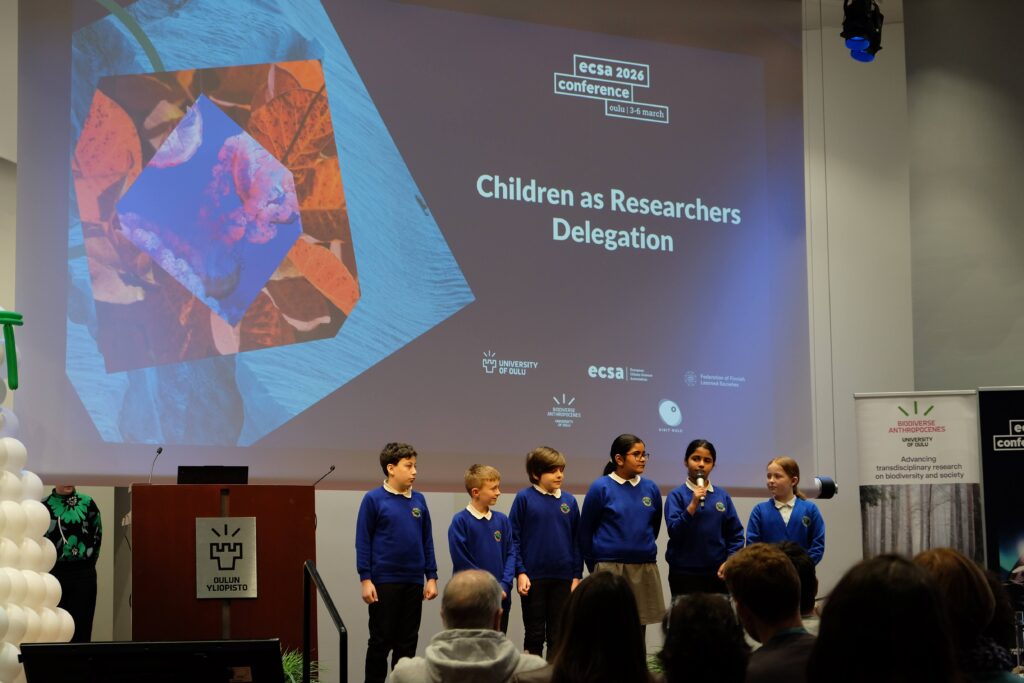
At the 2026 ECSA Conference in Oulu, we co-organized (with Rick Hall and Reidun Norvoll) a workshop on the theme of Children as Researchers. The headline for the workshop was Citizen science in educational settings other than Higher Education; when research is guided by the curiosity of young people what unexpected outcomes may arise?
The aim of the workshop was to explore these questions: What have been the opportunities/challenges, (scientifically, ethically, practically) of children as researchers? What further opportunities for Citizen Science across generations can be envisaged? Workshop participants are invited to share other case studies and be guided by the children from UK, YouCount Norway and Finland towards a wider debate. Children will open the workshop and have the final word – what happens in between is open to the curiosity of those who attend.
The presence of children (from Wellbeck School, Nottingham UK, aged 9 and 10 years old) lifted the tone of the workshop attended by 70 delegates to the conference, and the children went on to engage with over 100 other conference attendees in surveys about our closeness to Nature, and led further creative activities at the ECSA Festival in the Oulu city centre.
The children made a breaking statement during the workshop and at the conference closing ceremony: they called for more international research collaboration of children. Their call that there should be more children at the next conference (in Lisbon 2028) was warmly welcomed.
Some publications linked to these topics
Pankiv, K., Kloetzer, L. (2024). Does using Artificial Intelligence in Citizen Science support volunteer’s learning? An experimental study in ornithology. Citizen Science Theory and Practice. 9(1), 36, DOI: 10.5334/cstp.733
Kloetzer, L. (2024). Beyond procedural ethics: A four levels-architecture for research ethics in qualitative research. In Eleftheria Tseliou, Carolin Demuth, Eugenie Georgaca & Brendan Gough (Eds). The Routledge International Handbook of Innovative Qualitative Psychological Research.
Nissille, C., & Kloetzer, L. (2023). Le Glossaire: 125 ans de sciences citoyennes en dialectologie. Etica & Politica, 25(2), 55-79.
Kloetzer, L., Junqueira de Aguiar, W. M. & Fidalgo, S. (2023). Reflexões sobre Metodologias de Pesquisa: Perspectivas de Colaboração em Investigações Crítico-Educacionais/Reflections about Research Methodologies: Collaborative Perspectives in Critical-Educational Investigations/Réflexions sur les méthodologies de recherche : perspectives collaboratives dans les investigations critiques en éducation.
Mata-Codesal, D., Kloetzer, L., Maiztegui-Oñate, C. (2020). Editorial: Strengths, Risks and Limits of Doing Participatory Research in Migration Studies. In Special Issue: Participatory Methods in Migration Research, guest edited by Diana Mata-Codesal, Laure Kloetzer, Concepción Maiztegui-Oñate. Migration Letters, 17(2), 201-210, https://journals.tplondon.com/ml/issue/view/81
Jennett, C., Kloetzer, L., Schneider, D. Iacovides, I. Cox, A., Gold, M., Fuchs, B., Eveleigh, A., Mathieu, K., Ajani, Z., Talsi, Y. (2016). Motivations, Learning and Creativity in Online Citizen Science. Journal of Science Communication, 15(3).
Kloetzer, L., Schneider, D. & da Costa, J. (2016). Not so passive: engagement and learning in Volunteer Computing projects. Human Computation, 3(1), 25-68.